
Meta’s Value Is Plummeting
- The Growing Legal Threat
- Could Meta Face a Tobacco-Style Settlement?
- What Investors Should Consider
- Surveillance Capitalism and Moral Hazard
- The Bottom Line
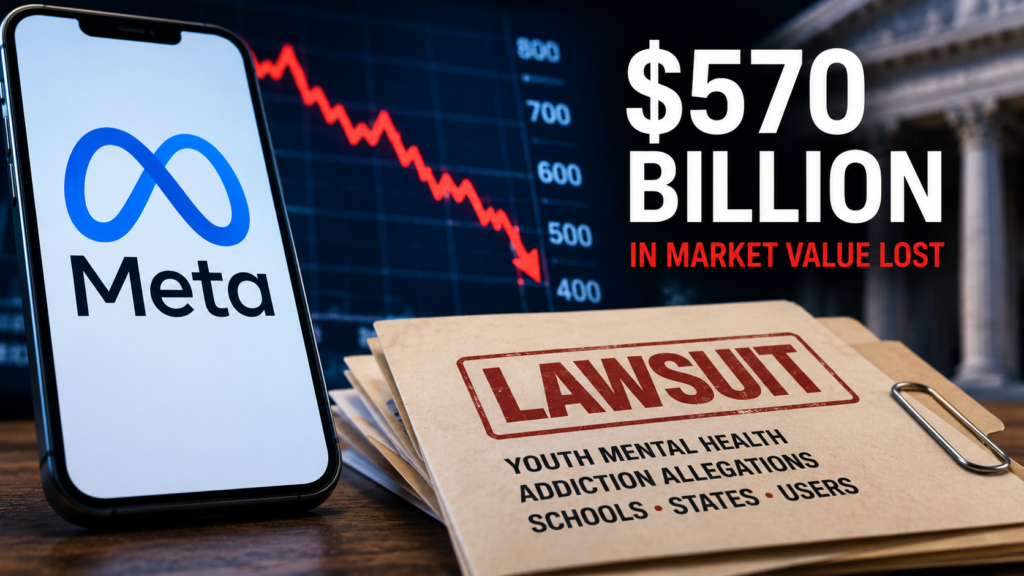
Meta Platforms reached a peak valuation in August 2025 when the stock traded near $790 per share. Since then, the company has lost approximately 29% of its value, erasing roughly $570 billion in market capitalization.
To put that figure into perspective, $570 billion exceeds the annual economic output of countries such as Belgium, Austria, Norway, or Thailand. It is larger than the market value of many Fortune 50 companies and approaches the scale of some of the largest corporate value declines in modern history.
The question investors should be asking is simple: Is this merely another market correction, or is the market beginning to price in risks that could fundamentally affect Meta’s future valuation?
The Growing Legal Threat
One of the most significant risks facing Meta is the rapidly expanding wave of litigation involving social media addiction and youth mental health.
Plaintiffs are increasingly relying on a legal theory that closely resembles the arguments successfully used against tobacco companies:
- The company knew its product was harmful.
- Internal research documented those harms.
- The company continued optimizing for engagement and profit.
- Product features were intentionally designed to encourage addictive behavior.
- Users and parents were not adequately warned.
This theory is now at the center of thousands of lawsuits involving Meta, Instagram, TikTok, Snap, and YouTube.
The Federal Multi-District Litigation
The largest case is MDL 3047, which consolidates thousands of social media harm lawsuits involving Meta and other major platforms.
Plaintiffs include:
- Individual users
- Parents
- School districts
- State governments
- Tribal governments
The cases allege that platform design contributed to addiction, anxiety, depression, eating disorders, self-harm, and suicide among young users.
Meta Has Already Lost Important Cases
These are no longer merely allegations.
A California jury found Meta and YouTube liable in what is widely regarded as the first social media addiction personal injury trial. The plaintiff was awarded approximately $6 million, with Meta responsible for most of the damages.
Separately, a New Mexico jury found that Meta violated state law involving harms to children and imposed approximately $375 million in penalties.
While these verdicts are not financially significant to a company of Meta’s size, they provide future plaintiffs with a legal roadmap.
School Districts and States Are Suing
Approximately 1,200 school districts have filed claims alleging that social media companies contributed to youth mental health problems while imposing significant costs on schools.
At the same time, a bipartisan coalition of more than 30 state attorneys general has sued Meta, alleging that Facebook and Instagram were knowingly designed to addict young users and contribute to the youth mental health crisis.
States possess the ability to seek both financial penalties and operational restrictions, making these cases particularly important.
Could Meta Face a Tobacco-Style Settlement?
There is currently no equivalent to the 1998 Master Settlement Agreement that ultimately cost tobacco companies more than $200 billion.
However, many of the same ingredients are beginning to emerge:
- Internal company documents
- Multiple state actions
- Thousands of private lawsuits
- School district claims
- Early plaintiff victories
- Growing political pressure
No one knows whether social media litigation will ultimately follow the path of tobacco, asbestos, opioids, or PFAS litigation.
The critical event may be the upcoming bellwether trials. If Meta continues losing representative cases before juries, settlement pressure could increase dramatically.
What Investors Should Consider
The immediate financial impact of current verdicts is insignificant relative to Meta’s size.
A few hundred million dollars is effectively a rounding error for a company with a market capitalization exceeding $1 trillion.
The real risk is not a single verdict. The real risk is a scenario in which liability becomes systemic.
Investors should pay attention to several developments:
- Repeated jury findings that Meta knowingly designed addictive features for minors
- State-imposed operational restrictions
- Expansion of successful plaintiff verdicts
- Emergence of a nationwide settlement framework
That is the point at which litigation risk could become a major valuation issue rather than a manageable legal expense.
Comparing Today’s Decline to the Metaverse Collapse
Investors may remember Meta’s previous collapse following Zuckerberg’s decision to pursue the Metaverse strategy.
Meta spent approximately $80 billion on Reality Labs while attempting to build a virtual world that never achieved the adoption many had predicted. During that period, the company lost roughly $700 billion in market value and the stock declined approximately 75% from its peak.
The difference is that the Metaverse collapse was primarily driven by concerns about capital allocation and business strategy.
The current decline appears to be driven by a different set of concerns, including litigation exposure, regulatory pressure, AI spending, and slowing expectations for future growth.
The market has already erased an amount of value larger than the entire market capitalization of many Fortune 50 companies, and the decline continues despite Meta remaining enormously profitable.
Surveillance Capitalism and Moral Hazard
Beyond the financial considerations, investors must decide whether they are comfortable with the business model itself.
Meta’s profitability is built upon the collection, analysis, and monetization of user data. Critics argue that this model creates incentives that may not align with the best interests of users, particularly younger users.
The rapid expansion of artificial intelligence has raised additional concerns regarding the use of copyrighted content and creative works to train large language models without direct compensation to creators.
These issues remain matters of public debate, but they increasingly influence how investors evaluate long-term corporate risk.
The Bottom Line
Meta remains one of the most profitable companies in the world.
The question is not whether Meta is profitable today.
The question is whether investors are adequately accounting for the legal, regulatory, and reputational risks that may affect the company’s future.
If the Metaverse collapse was a Category 5 hurricane for shareholders, the current decline is already approaching Category 4.5 in terms of value destroyed.
The outcome of the major social media litigation now working its way through the courts may determine whether this drawdown becomes a temporary correction or the beginning of a much larger repricing of risk.

Wall Street veteran, educator, and founder of Moneygrow.com®, with nearly 10,000 trading days of investment management experience since 1987. He helps individuals, families, trusts, and business owners make informed financial choices through disciplined investment management, financial education, and personalized strategic guidance.