
Lessons in patience and perspective when the pressure to sell is greatest.
In this feature
- The Pressure to Sell
- The Business Behind the Headlines
- Every Completed Sale Has a Buyer
- A Sudden Reversal
- The Discipline to Pause
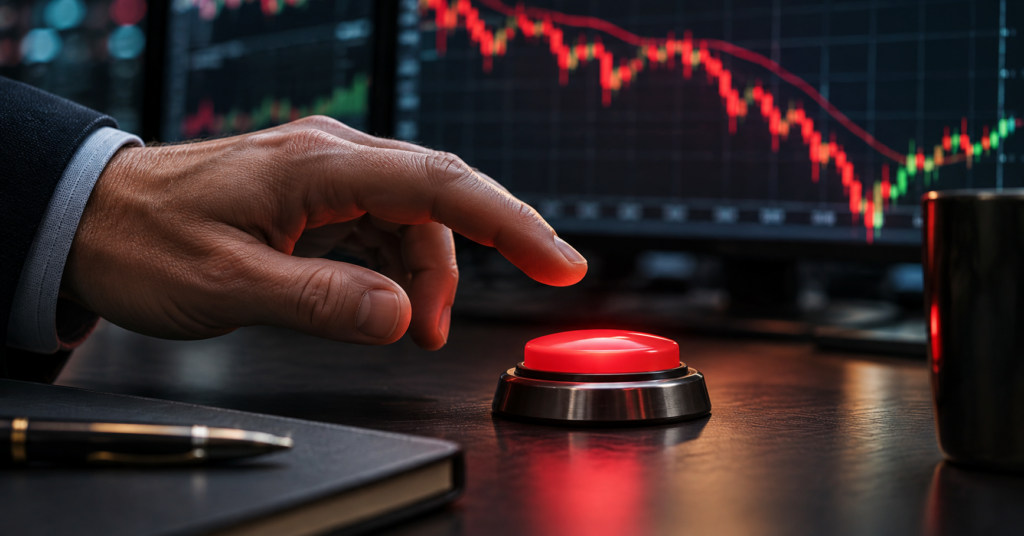
A wise investor avoids being trigger-happy in the midst of dramatic market shifts. That is easy to say when markets are calm and far harder to practice when investment values are falling sharply. During the recent tech selloff, watching substantial declines in positions I manage was deeply uncomfortable. My fiduciary responsibility is to manage the capital entrusted to me with care, and that responsibility makes the temptation to act especially powerful.
After close to 10,000 trading days, I have learned to be cautious about dramatic stories that seem to demand an immediate response. Experience has shown me how quickly the circumstances driving a market reaction can change. That experience does not remove uncertainty or make losses easy to watch. It does remind me to pause long enough to consider what the news actually means for the investment.
The Pressure to Sell
When confidence in a prominent business leader suddenly breaks down, the temptation to sell can be enormous. Investors must consider whether the leadership disruption threatens the company’s ability to deliver on its promises. At the same time, the emotional force of the story can overwhelm attention to the business itself. For me, NVIDIA’s recent leadership turmoil has become a textbook example of that tension.
NVIDIA’s decline exceeded the tolerance I normally apply to a holding and triggered a red alert in my daily portfolio monitoring system. That intensified the pressure to sell and protect portfolio gains. I did not trade. Trading at that point, particularly amid the heightened volatility, would have conflicted with some of my standing rules for market engagement:
- I do not trade on days when market prices are declining. I want time to assess whether the price action reflects a temporary move or a change in the established trend.
- I never trade on a Friday. I prefer to evaluate weekend developments before making a new trade.
The Business Behind the Headlines
NVIDIA’s sales outlook remained a central consideration as its leadership situation unfolded. I needed to weigh the risks of continued ownership against the company’s operating prospects. Its November 17 financial report provided concrete information for that assessment:
- Revenue for the third quarter of fiscal 2027 was $115.8 billion, up 103% from the same quarter a year earlier. [1]
- Management forecast $130 billion in revenue, plus or minus 3%, for the following quarter, which includes an additional week. [1]
Those figures gave substance to the case for continuing to evaluate NVIDIA on its operating prospects. A revenue forecast is still a forecast, and strong sales alone cannot settle questions about valuation, profitability or leadership risk. A change at the top can affect execution, customer confidence and the reliability of those expectations. The investment choice must account for all of those considerations.
NVIDIA also operates within an extensive network of companies involved in semiconductor development, manufacturing and use. [1] I had already begun developing an article about the breadth of those relationships and their significance to its business. My premise was that the strength of those established relationships deserves weight when evaluating a key participant’s prospects.
The revenue guidance deserved substantial weight, but it did not make the investment immune to further losses. The possibility of federal investigation or legislative scrutiny added uncertainty about the stock’s longer-term prospects. Ultimately, I gave greater weight to the company’s operating outlook, which supported my choice to hold as the story unfolded.
Every Completed Sale Has a Buyer
Every completed stock transaction has both a buyer and a seller. When someone sold NVIDIA during the decline, another party purchased those shares. When you buy, someone else sells; when you sell, someone else buys. The parties can have different objectives, time horizons and reasons for acting, so the transaction itself does not tell us which choice will prove more rewarding.
Liquidity describes how readily shares can be traded without substantially affecting their price. A buyer’s presence does not guarantee a seller the price they want, and a seller seeking an immediate transaction may have to accept a lower bid. A completed trade establishes a price at which ownership changes hands; it does not settle what the business is worth. [2] [3]
The bid-ask spread, the gap between quoted buying and selling prices, is often narrow for actively traded stocks during regular market hours. Outside those hours, lower trading activity can widen the spread and make execution less favorable. [6] That is one reason we do not trade outside regular market hours.
A Sudden Reversal
On November 23, NVIDIA announced that Jensen Huang had been reinstated as president and chief executive officer, while confirming that its independent investigation would continue. [4] Reuters reported that NVIDIA shares closed approximately 31% higher that day. [5] The speed of that reversal illustrates how abruptly the circumstances surrounding an investment can change.
For an investor who sold just before the rebound, returning to the position could suddenly become considerably more expensive. That is one difficulty with selling in response to alarming news while expecting a convenient opportunity to buy back. A recovery can begin while significant uncertainty remains.
A single rally cannot establish that every seller made a poor choice or that the risks have disappeared. The quality of an investment choice must be assessed against the information available when it was made. The reversal does, however, show why the pressure to act deserves careful scrutiny before a trade is placed.
The Discipline to Pause
Taking a pause is part of managing capital responsibly. It creates room to examine whether new information has changed a company’s prospects, the risks of owning it or its place in a portfolio. When the evidence warrants reducing or selling a position, action is appropriate. When the evidence continues to support ownership, restraint can also be a responsible choice.
The experience of the past two weeks has reinforced that principle for me. The urge to trade can become strongest when uncertainty makes clear thinking most difficult. Taking a breath gives us a chance to evaluate what has changed and what a transaction would accomplish. Before pulling the trigger, make sure the evidence supports the choice.
Sources
[1] NVIDIA. Financial Results for Third Quarter Fiscal 2027. November 17, 2026
[2] Investor.gov. Liquidity (or Marketability)
[3] FINRA. Understanding Market Liquidity and Your Investments
[4] NVIDIA. Board Reinstates Jensen Huang as President, CEO and Board Director. November 23, 2026
[5] Reuters. Wall Street soars as Nvidia reinstates Huang, Treasury yields rise November 23, 2026 report
[6] Investor.gov. Extended-Hours Trading: Investor Bulletin
Financial Guidance Begins with a Conversation
Your circumstances, responsibilities, and priorities are your own. A conversation with Frederick can help clarify where you are, what concerns you most, and which of the Keystone Services may be appropriate for you.
KEYSTONE GUIDE
Financial Planner: What Does That Really Mean?
The title “financial planner” can describe professionals working under very different credentials, compensation arrangements, regulatory responsibilities, and business models.
Frederick Ravid examines how the profession developed, what those differences may reveal, who may actually be managing your investments, and the questions every investor should ask before choosing an adviser.
Read this foundational guide to understand both the financial planner and the business behind the advice.

Wall Street veteran, educator, and founder of Moneygrow.com®, with nearly 10,000 trading days of investment management experience since 1987. He helps individuals, families, trusts, and business owners make informed financial choices through disciplined investment management, financial education, and personalized strategic guidance.