

In This Report:
- Don’t Confuse Changing Headlines With Changing Business Fundamentals
- A Chinese IPO Sparks a Semiconductor Sell-Off
- The Headlines Tell Only Part of the Story
- Not Every Company Was Affected for the Same Reason
- Markets Often Show Evidence of Investor Overreaction
- The Bigger Picture
- The Takeaway
- Looking Beyond Today’s Headlines
Don’t Confuse Changing Headlines With Changing Business Fundamentals
Headlines can move stock prices in a single day. Understanding what those headlines really mean can influence investment choices for years. For long-term investors, recognizing the difference between temporary market sentiment and lasting business fundamentals can have a profound impact on investment success.
Since the beginning of July, many of the stock market’s biggest technology winners suddenly became some of its biggest losers. Companies such as Nvidia, Broadcom, Micron, Seagate Technologies, and many others all came under heavy selling pressure. Several of these companies have experienced stock price declines of 20% or more. Headlines have pointed to everything from concerns about artificial intelligence spending to the spectacular initial public offering of a Chinese semiconductor company. Let’s look beyond the headlines and examine what may really be taking place.
A Chinese IPO Sparks a Semiconductor Sell-Off

ChangXin Memory Technologies (CXMT) is a Chinese company. The company began trading following its initial public offering on the Shanghai Science and Technology market on Monday, July 27, 2026. After years of substantial financial losses, the company recently turned the corner and reported positive earnings. The IPO was priced at 8.66 yuan per share, but intense investor demand caused the shares to close their first trading day at 49 yuan, which was a 466% rise above the offering price. This raised concerns that China may become a more formidable competitor. The IPO heightened concerns about future competition from China, contributing to a broad sell-off across semiconductor stocks. The selling quickly spread beyond CXMT’s direct competitors, affecting companies across the broader semiconductor industry, including Seagate, Nvidia, Broadcom, Samsung, SK Hynix, and many others.
The Headlines Tell Only Part of the Story
Imagine a neighborhood where all the homes doubled in value in one year. It wouldn’t take much bad news to convince some owners to lock in their profits. The same behavior can take place in the stock market. Many of the semiconductor-related stocks that declined over the last couple of trading days have had extraordinary gains. When investors decide to take profits, their selling can temporarily push prices lower, even if the underlying businesses remain strong.
This is not the time to become reactive and follow the crowd. The real question we should ask at a time like this isn’t whether China will do this or that. Instead, we should ask:
Has the long-term demand for the products and services these companies provide fundamentally changed?
Right now, demand for artificial intelligence, data centers, cloud computing, networking, and advanced memory technologies remains exceptionally strong, with many of these trends expected to continue for years. A short-term decline in stock prices does not necessarily mean those long-term trends have been broken.
Not Every Company Was Affected for the Same Reason
Some companies were sold because investors feared increased competition from China. Others, such as Seagate and Western Digital, appear to have been pulled lower simply because investors were selling nearly everything associated with semiconductors. Even companies with very different business models and competitive positions were caught up in the broad selling.
When fear spreads through a market, investors often sell first and sort out the details later, and that’s exactly the kind of emotional reaction long-term investors should avoid. Before making investment choices, it’s worth asking whether the business itself has fundamentally changed or whether the market’s emotions have temporarily moved faster than justified by the facts.
Markets Often Show Evidence of Investor Overreaction
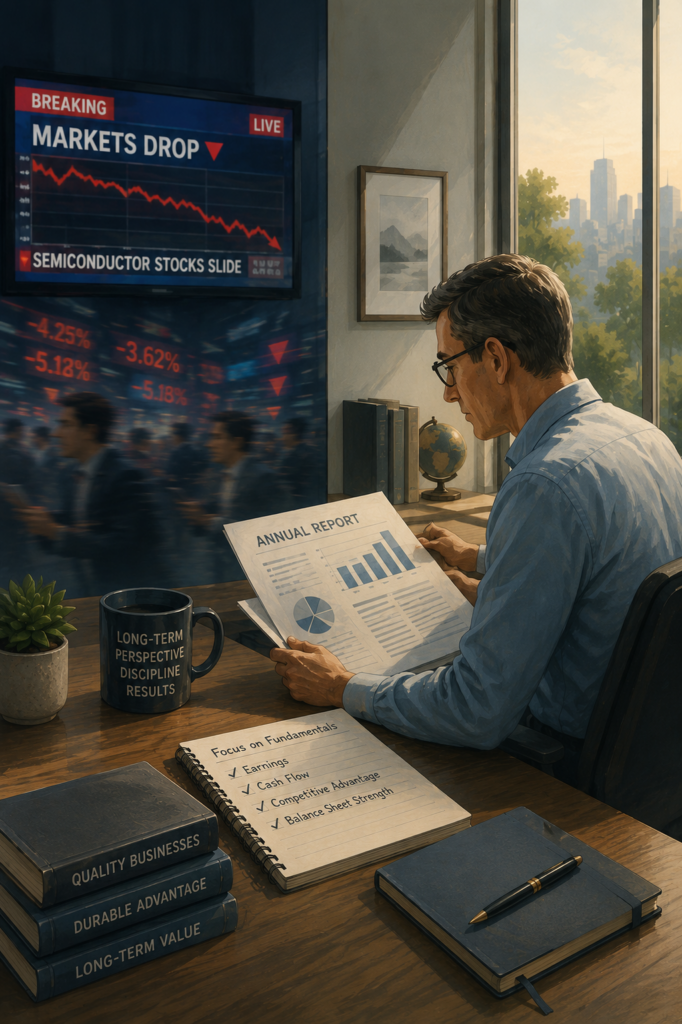
Human nature hasn’t changed much since the Stone Age. When uncertainty rises, fear often spreads faster than facts, causing investors to react emotionally before carefully evaluating the underlying businesses.
That same fear-and-greed dynamic plays out in financial markets every day. One alarming headline can trigger widespread selling as institutions and individual investors alike rush to protect themselves. As prices begin to fall, the downward momentum itself can encourage even more selling.
Long-term investors should be careful not to make major strategic choices based on a single headline or a few days of market activity. Before changing course, it is worth asking whether the underlying businesses have truly changed. Or has the market simply reacted emotionally in the short term?
The Bigger Picture
Warren Buffett has often reminded investors, “Never bet against America.” His point is that the United States has repeatedly demonstrated an extraordinary ability to innovate, adapt, and create wealth over long periods of time.
That does not mean America will win every competitive battle. We compete in a global economy, and countries such as China have become formidable competitors in many industries. Competition should be expected, and it often benefits consumers by encouraging better products, lower costs, and faster innovation.
The important question for long-term investors is not whether competition exists. It always has. The real question is whether the businesses you own are continuing to solve important problems, create value, and meet growing demand. Companies that continue to do those things have historically found ways to prosper despite intense competition.
Now step back and look at the bigger picture.
Worldwide, trillions of dollars are expected to be invested over the coming decades in artificial intelligence, data centers, electricity generation and grid modernization, robotics, medical technology, automobiles and transportation, defense systems, and communications infrastructure. Nearly every one of these long-term investment trends depends on increasingly powerful semiconductors.
Perhaps the greatest future demand for semiconductors will come from products and services that have not yet been invented, solving problems consumers and society have not yet encountered.
That does not mean every semiconductor company will succeed. It does mean that the long-term demand for advanced computing and electronic technology continues to expand. Short-term market volatility should not distract investors from the larger forces that are shaping the future.
The Takeaway
Markets constantly respond to new information. Successful investors do not change course because of every market reaction. Instead, they ask a more important question: Have the long-term business fundamentals changed? If the answer is yes, the investment thesis may need to be reconsidered.
If the answer is no, today’s headlines may simply become tomorrow’s forgotten market noise.
Looking Beyond Today’s Headlines
Successful investing isn’t about reacting to every market headline. It’s about understanding the businesses behind your investments and maintaining a long-term perspective when markets become emotional.
KEYSTONE GUIDE
Financial Planner: What Does That Really Mean?
The title “financial planner” can describe professionals working under very different credentials, compensation arrangements, regulatory responsibilities, and business models.
Frederick Ravid examines how the profession developed, what those differences may reveal, who may actually be managing your investments, and the questions every investor should ask before choosing an adviser.
Read this foundational guide to understand both the financial planner and the business behind the advice.
Financial Guidance Begins with a Conversation
Your circumstances, responsibilities, and priorities are your own. A conversation with Frederick can help clarify where you are, what concerns you most, and which of the Keystone Services may be appropriate for you.

Wall Street veteran, educator, and founder of Moneygrow.com®, with nearly 10,000 trading days of investment management experience since 1987. He helps individuals, families, trusts, and business owners make informed financial choices through disciplined investment management, financial education, and personalized strategic guidance.