
How a Technological Breakthrough Is Transforming One of the World’s Most Iconic Luxury Markets
Key Takeaways
- Why diamonds were never as scarce as most people believed.
- How laboratory-grown diamonds are changing the economics of the industry.
- Why China has become the world’s manufacturing leader.
- Why diamonds are becoming critical engineering materials.
- What De Beers and SpaceX reveal about the economics of scarcity.
- The investment lesson every long-term investor should understand.
For more than a century, diamonds occupied a unique place in the global economy. They symbolized wealth, commitment, permanence, and rarity. Generations of consumers believed their value was rooted in nature—that diamonds were scarce because they required billions of years to form deep beneath the Earth’s surface.
Today, that assumption is being challenged.
A technological revolution has dramatically altered the economics of the diamond industry. Laboratory-grown diamonds are chemically, physically, and optically identical to mined diamonds. As manufacturing technology has improved and production expanded, prices have fallen dramatically, reshaping both the jewelry market and the future of diamond manufacturing.
Scarcity Was Only Part of the Story
Diamonds have never been as naturally scarce as many consumers believed.
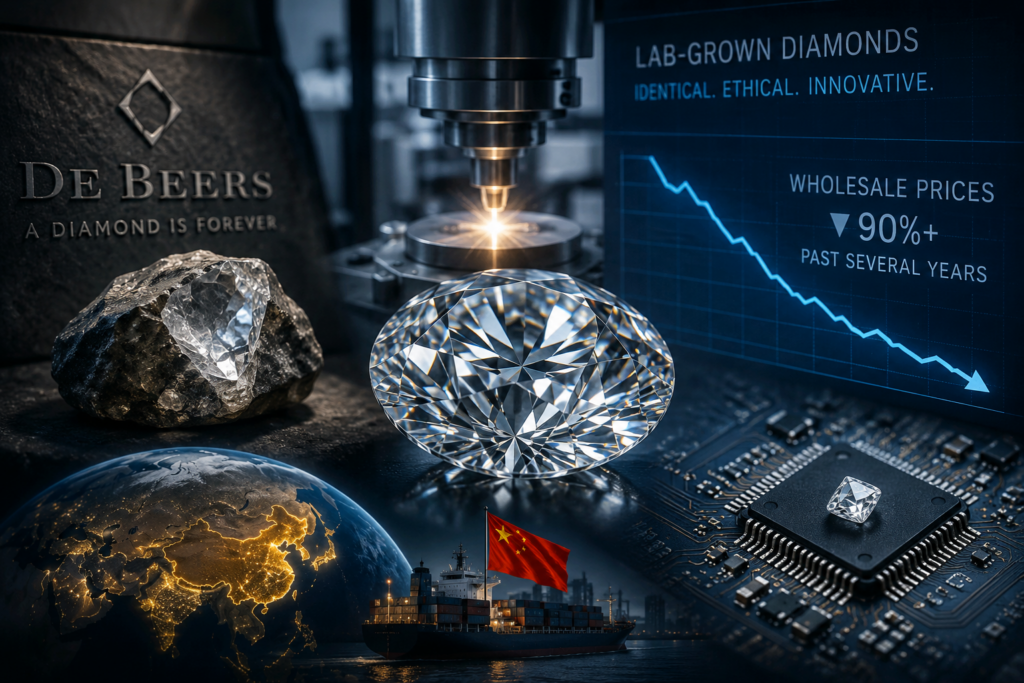
Beginning in the late nineteenth century, De Beers built one of the most successful business models in modern history by acquiring mines, controlling distribution, limiting supply, and investing heavily in advertising. For decades, the company controlled much of the world’s rough diamond production while successfully convincing consumers that a diamond engagement ring represented everlasting love.
Its famous slogan, “A Diamond Is Forever,” became one of the most successful advertising campaigns ever created and fundamentally changed consumer behavior around the world.
This combination of supply management and brilliant marketing helped support diamond prices for generations. The lesson extends well beyond the jewelry industry: markets frequently place a premium on assets whose supply is deliberately constrained.
Technology Changed the Economics
Laboratory-grown diamonds are chemically, physically, and optically identical to mined diamonds. Using HPHT and CVD manufacturing, producers can create genuine diamonds with the same crystal structure and optical properties as natural stones.
As production expanded, wholesale prices fell by more than 90 percent over the past several years. The technology did not change what a diamond is—it changed how easily one could be produced. Once scarcity disappeared, prices adjusted accordingly.
China Became the Manufacturing Leader
China, particularly Henan Province, has become one of the world’s largest producers of synthetic diamonds. What began as an industrial materials industry has evolved into a sophisticated manufacturing base capable of producing gem-quality stones at enormous scale.
This manufacturing expertise has reduced production costs while placing significant competitive pressure on traditional diamond mining companies.
The Bigger Story Isn’t Jewelry
Synthetic diamonds are among the best thermal conductors known, making them valuable for high-performance electronics. Researchers are actively developing diamond-based technologies for power semiconductors, quantum sensing, advanced optics, laser systems, and next-generation computing.
Laboratory-grown diamonds may have reduced the scarcity value of gemstones while simultaneously increasing the importance of diamonds as advanced engineering materials.
Even the Grading System Is Changing
The Gemological Institute of America (GIA) introduced a new approach for describing laboratory-grown diamonds rather than using the traditional grading terminology developed for natural stones, reflecting the increasingly consistent quality achieved by modern manufacturing.
From Diamonds to SpaceX: The Economics of Scarcity
The diamond industry teaches an investment lesson that reaches far beyond gemstones.
For decades, De Beers demonstrated that controlling supply could help support prices. Diamonds were valuable not only because they were difficult to mine, but because relatively few entered the marketplace at any given time.
Modern capital markets continue to illustrate the same principle.
One of the most closely watched examples is the proposed SpaceX initial public offering. Based on the company’s publicly disclosed plans, only about 5% of the company’s shares are expected to become publicly tradable, while the overwhelming majority remain in the hands of Elon Musk, employees, early investors, and other insiders.
Many traditional IPOs offer 15% to 20% of their shares to public investors. By limiting the supply of publicly available shares while investor demand is expected to be exceptionally strong, SpaceX illustrates the same economic principle that De Beers employed for decades: when supply is intentionally limited, scarcity itself can contribute to higher prices.
The comparison is not perfect. Diamonds are a commodity, while SpaceX represents ownership in an innovative business. Nevertheless, both demonstrate that price is determined not only by intrinsic value, but also by the relationship between supply and demand.
What Investors Should Take Away
Technological innovation has repeatedly transformed industries built upon scarcity. History has seen similar shifts in semiconductors, solar panels, memory chips, batteries, and now diamonds.
At the same time, innovation can create entirely new sources of demand. While laboratory-grown diamonds have disrupted the traditional jewelry market, they are simultaneously becoming increasingly important as advanced engineering materials.
For investors, understanding how innovation reshapes supply, demand, and competitive advantage is often more valuable than simply following today’s market prices. Sometimes the most important story is not about the product everyone recognizes—it is about the economic forces quietly changing the value behind it.

Wall Street veteran, educator, and founder of Moneygrow.com®, with nearly 10,000 trading days of investment management experience since 1987. He helps individuals, families, trusts, and business owners make informed financial choices through disciplined investment management, financial education, and personalized strategic guidance.